ISO 45010: the first international standard for menstruation and menopause in the workplace. What does it mean in practice?
On September 7, 2026, an ISO standard was released that no one was talking about five years ago. If you are an HR manager, facility manager, or workplace safety officer, here is what it says and where you can begin.
There is a type of problem in the workplace that no one reports. It is not in any workplace assessment (APV), it is never brought up in a meeting, and it never becomes a formal inquiry. An employee who is menstruating and does not have a pad on her does not fill out a form. She leaves the office, finds the nearest supermarket, comes back twenty minutes later, and tells no one why. Or she improvises with toilet paper and spends the rest of the day thinking about that instead of her work.
The standard that ISO released in September 2026 is the first international document to address exactly that.
What is ISO 45010
The official title is ISO 45010:2026, Occupational health and safety management, Menstruation and menopause in the workplace, Guidance.
It was released on September 7, 2026, and is part of the ISO 45000 family, the same family as ISO 45001, which is the occupational health and safety standard that many companies already work according to. ISO 45010 does not replace ISO 45001. It supplements it.
Two things are important to keep in mind from the start, as they are often misunderstood.
The first: it is a guidance document, not a certifiable standard. There is no ISO 45010 audit you can pass, and no certificate to hang in the reception. It is a structured set of recommendations.
The second: it applies to organizations of all sizes and in all industries, and ISO has included extra guidance for small and medium-sized enterprises. In other words, those that do not have a dedicated health and safety department, but an HR manager who also handles payroll, recruitment, and everything else.
Who is it written for
For management, leaders, HR professionals, and health and safety personnel. In practice, for anyone who makes decisions about what a workday looks like.
What it covers
ISO 45010 looks at six areas: culture, policies, manager training, workplace design, measuring the effort, and concrete adjustments.
Translated into an ordinary workday, this means the following.
Culture
If menstruation or hot flashes are mocked in a team, no one will ask about anything. The standard assumes that the taboo is the core problem, not a lack of goodwill. People do not stay silent because they have been told no. They stay silent because they never ask.
Policies
The recommendation is not to write a separate document that lives its own life, but to integrate the topic into existing policies: sickness absence, flexibility, diversity, and inclusion. And to revise it periodically, because the needs of a 28-year-old employee and a 48-year-old employee are not the same.
Manager training
A manager who does not know how to respond will answer poorly or avoid the conversation. Not out of malice. Out of embarrassment.
Workplace design
This is where the physical aspects lie: access to clean, private toilets, menstrual products made available, hygienic disposal, temperature, ventilation, seating comfort, and the possibility of standing up in sedentary jobs.
Measurement
Without data, an effort remains an intention. The standard suggests that you should know if what you did actually changed anything.
Adjustments
Flexible working hours, short unscheduled breaks when symptoms require it, and attention to shift work.
The numbers behind the standard
ISO refers to a study by the British Standards Institution among 6,494 women in seven countries. Three results are worth remembering:
- 68 percent believe that the employer should support health issues related to menstruation and menopause.
- 70 percent want clear processes from the employer, not case-by-case goodwill.
- 60 percent say that their employer has never, on their own initiative, spoken to them about support during menopause.
The last number is the most telling. It is not about rejection. It is about a conversation that has never taken place.
The area that is fastest to solve
Of the six areas, five require time. Culture changes over years. Policies require approvals. Manager training must be planned. Measuring presupposes that there is something to measure.
One single area can be solved in a week: the physical access to products.
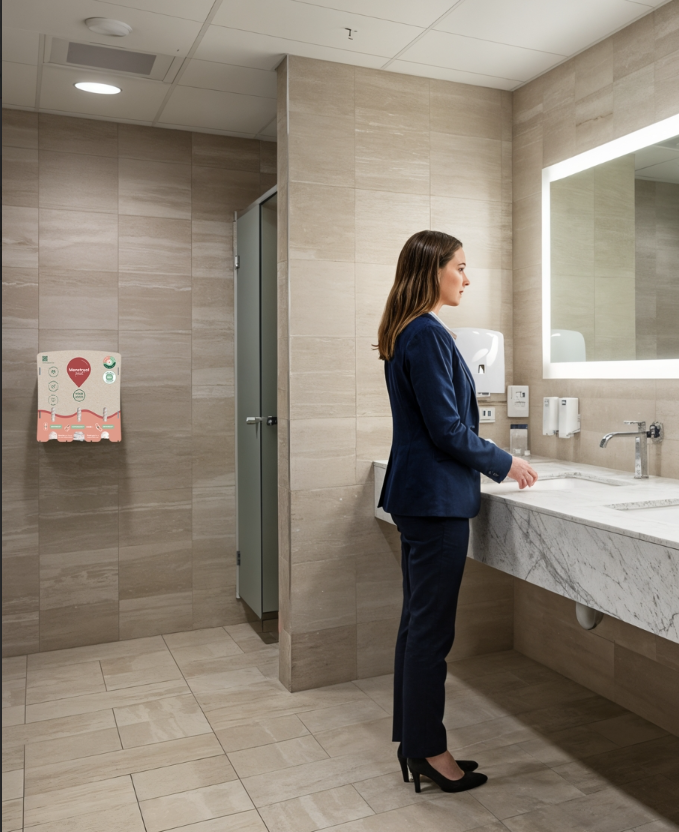
A dispenser with pads and tampons in the women's restroom solves a concrete problem the day it is installed. It requires no board decision, no training, and no internal campaign. And it has a side effect that most people do not anticipate: it makes the topic visible. A dispenser on the wall says, without a word being written, that menstruation here is not a private problem that you have to solve yourself.
Therefore, our answer is always the same when a company asks us where to begin. Begin with what you can do this month, not what you might be able to do next year.
The starting point in Denmark is actually good
Danish companies already work systematically with the work environment. There is a workplace assessment (APV) that needs updating and a safety organization that meets. ISO 45010 is not a new requirement on top of that. It is a checklist you can place alongside the APV that you have to go through anyway.
It is an inexpensive way to get started. You do not need a new project. You need one more point on an agenda that already exists.
Five things you can do in 30 days
- Count the women's restrooms at every location. The number is almost always lower than people think.
- Check if there is access to menstrual products. Not at the reception if someone asks. In the restroom.
- Check the disposal. A bin with a lid in every stall. It sounds trivial. It is not.
- Ask five female colleagues what is missing. Do not send a questionnaire to the whole house. Five conversations in five minutes give more than forty responses.
- Put up the products, and measure the consumption for two months. Only then should you have the talk about policy. Then you have data instead of assumptions.
What ISO 45010 is not
It is not a legal requirement. ISO standards are voluntary unless a contract, a customer, or a tender makes the requirement directly. And that is precisely where it becomes interesting for companies that act now. That is how other ISO standards have also started to become significant. Through tenders and customer requirements, not through legislation.
It is not only about menopause. It covers both, and menstruation has hitherto been the overlooked half. Most of what companies have done in recent years has focused on menopause, leaving a 24-year-old employee with endometriosis on the sidelines.
It is not a large expense. For a medium-sized organization, the physical part costs less per month than a single themed day per year.
What we provide
Femieko provides menstrual dispensers for offices, schools, educational institutions, clinics, pharmacies, the hotel and restaurant industry, and public spaces, with monthly refill and an annual report on consumption and environmental footprint.
The dispensers are mounted on a wall or tabletop, require no electricity, and are delivered filled. The refills are pads and tampons in individual packaging, with GOTS-certified organic cotton in the absorbent layers, clinically tested as hypoallergenic and non-irritating. The dispenser can be branded with your own logo, and this is free for orders of five dispensers or more.
If you need to evaluate your own workplace in relation to ISO 45010, the physical access is the place to start.
Calculate the monthly expense for your location →
Frequently asked questions
Is ISO 45010 a legal requirement?
No. It is a voluntary guidance document without certification. It becomes contractually relevant when a customer, a partner, or a tender makes the requirement directly.
What is the difference between ISO 45010 and ISO 45001?
ISO 45001 is the general standard for occupational health and safety management. ISO 45010 belongs to the same ISO 45000 family and provides specific guidance on menstruation and menopause, intended to work together with a system you already have.
Does it also apply to small businesses?
Yes. ISO has included extra guidance targeted at small and medium-sized enterprises without dedicated HR or safety resources.
Is it only about menopause?
No. It explicitly covers both menstruation and menopause.
Where do we begin, concretely?
With the physical access to products. It is the only area of the standard that can be solved in a few days, costs little, and provides a visible effect immediately. Culture and policy are built up concurrently.
Sources
- ISO, press release at launch, September 2026: iso.org/news/2026/09/iso-45010-launch
- ISO 45010:2026, the standard's page: iso.org/standard/45010
- The study ISO refers to: British Standards Institution, 6,494 women in seven countries