Care for you.
Down to the last detail.
Pads, panty liners and tampons made with organic cotton. See what they contain, how to choose, and what makes the difference in your routine.
*According to the FemiEko materials for this range. Composition and testing details vary by product.
Choose what you wear.
Know what you choose.
External or internal, for your period or the days in between. Find the right product and choose it on its product page.
-
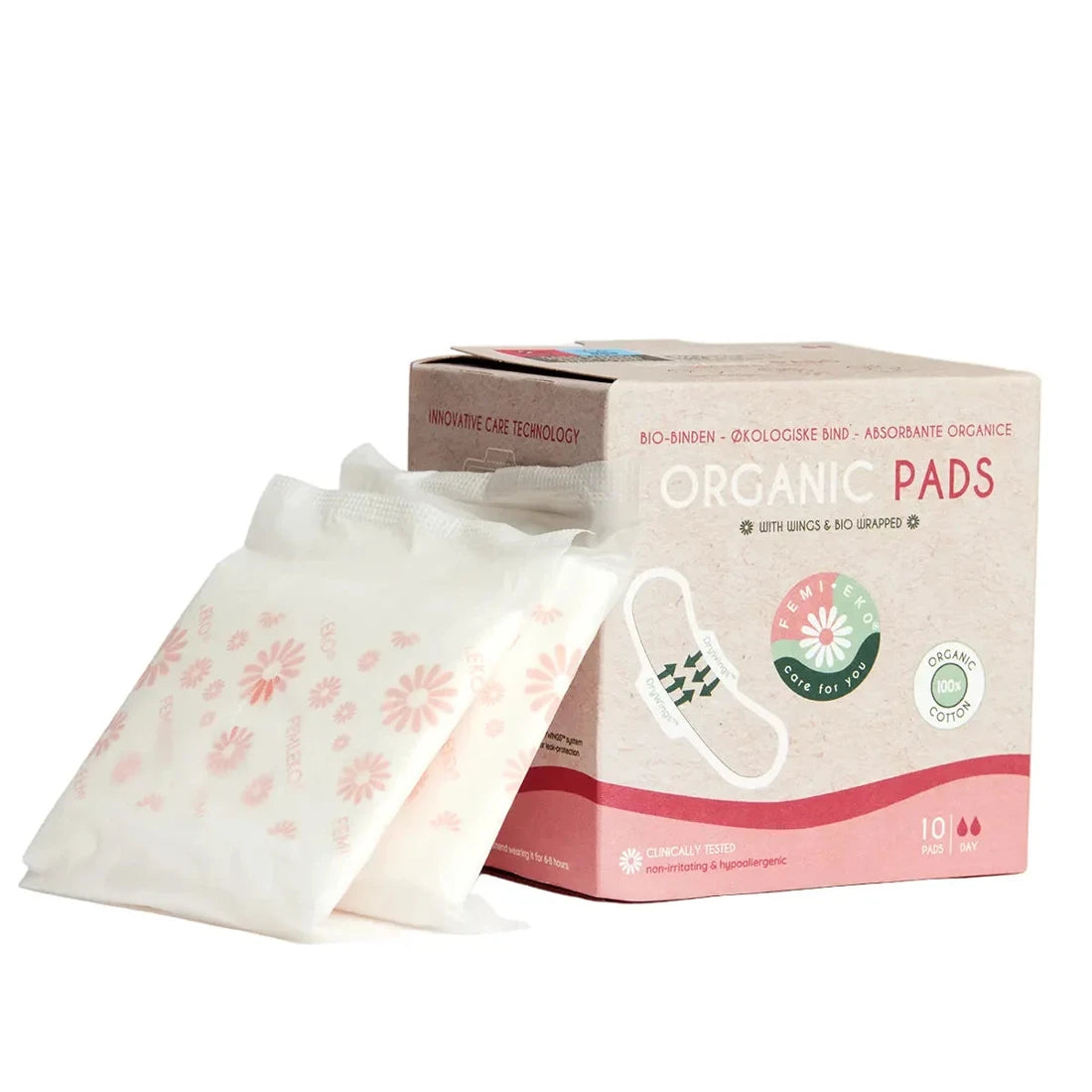
Ultra Day pads with wings
10 pcs · with wings
The comfort of cotton. Protection that stays in place.
View the product and buy ↗ -

Ultra Liners panty liners
24 pcs · ultra-thin
A thin layer of protection for the days between periods.
View the product and buy ↗ -
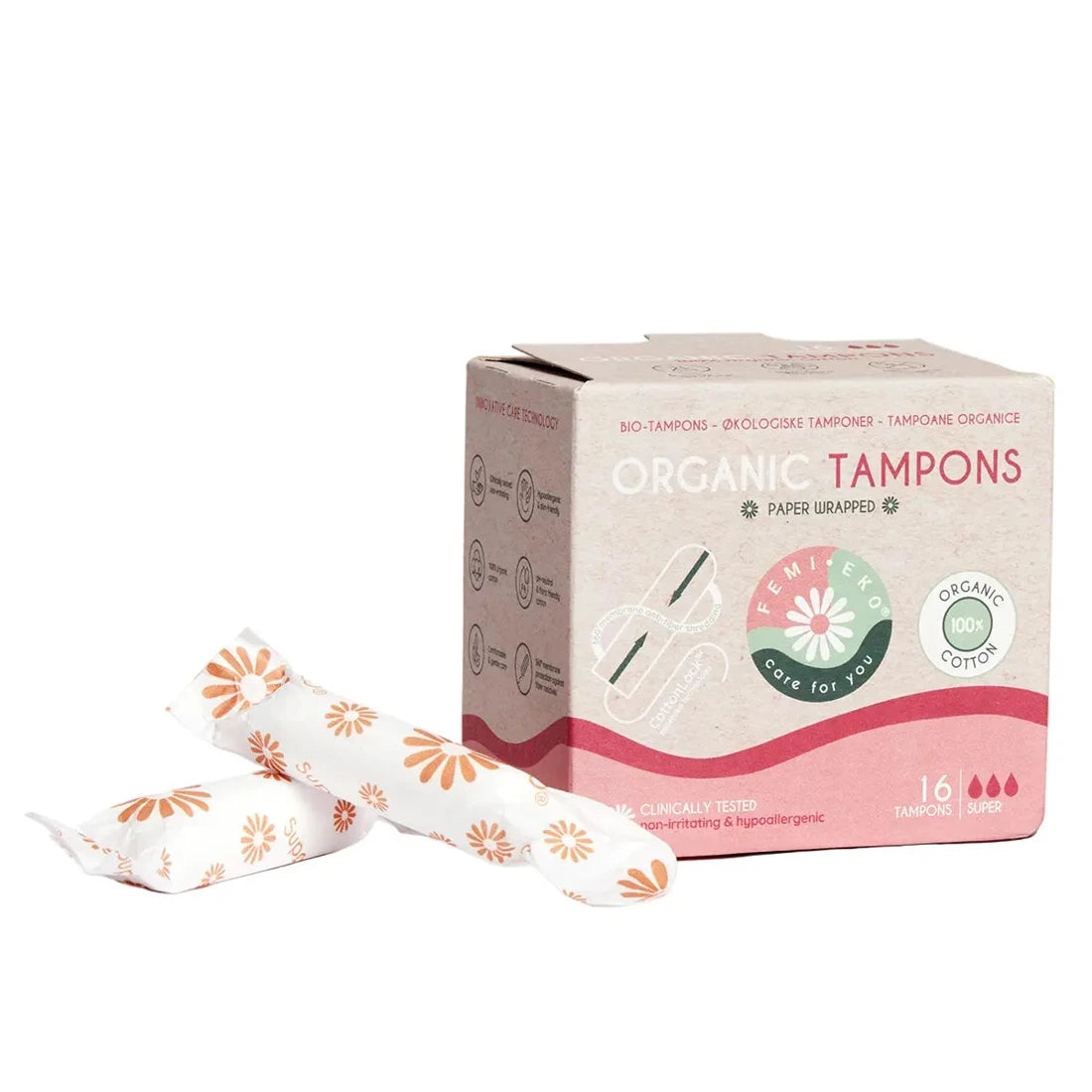
CottonLock™ tampons

Ultra Day pads · materials and use
- Top layer and absorbent core made with organic cotton.
- DryWings wings and adhesive fixing.
- Plant-based membrane, compostable and biodegradable.* No added fragrance.
Panty liners · materials and use
- For daily discharge, spotting or extra protection.
- Organic cotton in the layer that touches your skin.
- Plant-based membrane, compostable and biodegradable.* No added fragrance.
CottonLock™ tampons · materials and use
- Outer layer, absorbent core and string made with organic cotton.
- CottonLock™ helps keep the fibres within the structure of the tampon.
- Choose the lowest absorbency that suits your flow and follow the instructions for use.

Try several types before you choose a full pack.
Organic cotton in the absorbent layers.
Not only where it touches your skin.
On top: organic cotton
The gentle contact you are looking for, with no added fragrance.
In the core: organic cotton too
The organic cotton does not stop at the first layer. It also forms the absorbent core of Ultra Day.
At the base: plant-based membrane, compostable and biodegradable*
It helps protect your underwear and complements the absorbent cotton layers. A choice explained down to the last layer, not just the surface.
What is in them?
It says so on the pack.
You should not have to guess what you use. Here the materials are explained component by component, from the core to the packaging.
See the products in the range ↑- Core + outer layer + string
- 100% organic cotton
- Individual wrapper
- Cellulose-based paper
*The stated compostability and biodegradability refer to the membrane and to the documented certification conditions (industrial composting), not to home composting of a whole pad. Cotton, membrane, adhesive and packaging are different components. The organic cotton in the absorbent layers is GOTS-certified; the certification does not extend to the membrane, adhesives or packaging.
Put them side by side.
The difference is in the composition.
Cotton, viscose, plant fibres, SAP. They are not the same thing. Pick a category and see what is worth checking before you buy.
| What we compare | FEMIEKOFemiEko pads | Cotton on the surface + mixed core with a plastic membrane | Synthetic layer + mixed core with a plastic membrane |
|---|---|---|---|
| The layer against the skin | Organic cotton | Can be cotton, including organic | Can be a synthetic non-woven |
| The absorbent core | Organic cotton | Plant fibres / cellulose pulp + SAP | Cellulose pulp, sometimes + SAP |
| The bottom membrane | Plant-based membrane, compostable and biodegradable* | Plastic | Plastic |
| What to check | Cotton in the top layer and in the core of Ultra Day | Cotton on the surface says nothing about the core | The contact material and the core are different components |
↔ On mobile, swipe the table to see all variants.
| What we compare | FEMIEKOCottonLock™ tampons | Other tampons 100% organic cotton | Cotton + viscose / rayon | Viscose / rayon with a cover |
|---|---|---|---|---|
| The absorbent material | 100% organic cotton | Can also be 100% organic cotton | A blend of cotton and viscose | Viscose / rayon |
| The body of the tampon | Compressed organic cotton with a CottonLock™ protective cover | Compressed organic cotton; construction differs between products | Compressed fibres; construction differs between products | Compressed fibres; the cover may include synthetic material |
| The protective cover | Organic cotton; CottonLock™ helps keep the fibres within the structure | Check whether there is a cover and what it is made of | Check the material and how much of the surface it covers | Check whether it includes synthetic fibres, such as polyester or polypropylene |
| The string | Organic cotton | Check separately | Check separately | Check separately |
↔ Swipe to see all material combinations.
Compressed cotton is not a defect in itself. The difference in construction should be checked for each product. Construction alone does not prove a difference in safety.
Examples of constructions, not descriptions of all products on the market. Composition differs from product to product. Materials alone do not prove a difference in safety or absorbency. About tampon materials — FDA (in English) ↗
*The statement applies to the membrane and the certification conditions, not to home composting of the whole product.
And if the label says “bamboo”?
Check the full name: “bamboo viscose” describes a regenerated cellulose fibre, not cotton. Neither “plant-based” nor “organic” replaces the list of components. Cotton naturally contains cellulose, which is why we do not use the promise “cellulose-free”.
A detail
you can understand.
CottonLock™ is the protective cover that helps keep the fibres within the structure of the tampon. A detail that the word “organic” alone does not explain.
Do not stop at the promise. See the product and read what it contains.
The description applies to the construction of FemiEko tampons. It is not a safety comparison and does not change the fact that the risk of toxic shock syndrome exists with all tampons.
Natural questions.
Clear answers.
Are all the layers made of organic cotton?
For the Ultra Day pads, the top layer and the absorbent core are organic cotton; the bottom membrane is plant-based, compostable and biodegradable*. For the tampons, the outer layer, the core and the string are organic cotton. Composition differs between products. The organic cotton in the absorbent layers is GOTS-certified; the certification does not extend to the membrane, adhesives or packaging.
Can I compost the pad at home?
The plant-based origin of the membrane does not prove that the whole pad can be composted at home. Check the instructions on the pack and your local waste rules. Do not flush the products down the toilet.
How do I choose between pads, liners and tampons?
Pads give external protection for your period. Liners suit daily discharge, spotting or extra protection. Tampons give internal protection: choose the lowest absorbency that suits your flow and follow the instructions on the pack.
Does organic cotton remove the risk of TSS?
No. The rare but serious risk of toxic shock syndrome also exists with organic cotton tampons. Follow the wear time on the pack and do not wear a tampon for more than 8 hours. For long sleep, choose external protection. Read the NHS advice ↗